

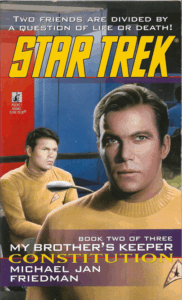
In today’s episode, when Kirk lets everyone know he’ll be alone in his bunk, he means it. But when the line of succession leaves him in the hot seat on the bridge, he has to learn on the fly who to sacrifice and when. Do Jim and Gary still have the romantic chemistry they had at the Academy? What’s up with all the cover-ups? And is there a satisfying secret option for Kirk to take this time? All this and more in Constitution, the book that wants to know if you would like to know (what’s) more.
Constitution
Author: Michael Jan Friedman
Pages: 267
Published: January 1999
Timeline: Seven years after Republic (TOS #85, My Brother’s Keeper #1)
Prerequisites: There is a running thread that I haven’t brought up because it looks like it’s going to take all three books to come into focus, but it started in Republic and continues here
For a series that’s nominally about James Kirk reminiscing about his friend Gary Mitchell, there’s not much time to think about that at the start of this one. Lee Kelso’s funeral goes off without a hitch, and the classic crew starts locking in. Sulu transfers to helm, McCoy and Uhura are on the way, David Bailey is set to replace Mitchell as lead navigator (though not for long, as you might recall), and the Enterprise has to stop off at Starbase 33 to give an official record of what just went down at Delta Vega.
This business takes up nearly a full 20 percent of the book. In fact, it seems like Friedman would have been perfectly content to marinate in this transitional moment if he didn’t already have an ongoing story to tell about James Kirk and Gary Mitchell. In his own sweet time, however, he finally finds a minute for Kirk to sit with his thoughts, which take the captain back to the moments on the Farragut just after a mysterious cloud sapped the life force of Captain Garrovick and half the crew.
It’s not long after that that he gets on the Constitution as the ship’s second officer. He earned a commendation for his actions on the Farragut, but wrestles with guilt over hesitating while stationed at the phaser cannons, because that was all it took for the cloud to get onto the Enterprise and wreak its havoc. As a result, he’s a dour sadsack on the Constitution when Gary Mitchell arrives, not socializing with anyone and saying as little as possible when he has to.
While Kirk’s busy feeling sorry for himself, Starfleet sends the Constitution to Sordinia IV to investigate some mysterious satellites that have appeared around the planet.1 Once the captain and the first officer beam down and leave him in charge, the satellites start firing on the capital (and the capitol). When he destroys one, more of them start bombarding the planet, and some turn their attention to the Constitution. When the mothership shows up and joins in the fun, Kirk has some hard choices to make that might require him to sacrifice some crew members—but will he pull the trigger in time, or freeze up and let disaster in like he did on the Farragut?
Constitution is mostly here to help shed some light on how Kirk learned to make the hard decisions and establish why he always tries to enact the option that reduces casualties first. Losing nearly everyone on the Farragut makes him desperate to lose no one in future situations, but as a young lieutenant, he still has a lot to learn about when sacrifice is necessary. Most of the best tension in Constitution comes from older, wiser officers knowing this and trying to tell Jim as much without diving headfirst into insubordination while Jim racks his brain trying to find the Kobayashi Maru cheat code that saves everyone. Jim still hasn’t entirely shaken this tendency by “Where No Man Has Gone Before”; he’s reluctant to kill Gary because of their friendship, and is only properly talked into it by Spock and his heartless yet undeniable logic. Unfortunately, it will still be many years before Spock makes the choice obvious with a pithy sound bite.
Republic made a big splash straight out of this trilogy’s gate by creating, whether intentionally or not, a strong erotic charge between Jim and Gary. I regret to report that there’s much less of that here, because it really helped keep Republic from sagging too badly, but there’s much less of any sort of connection of any kind between them here. The combination of Kirk’s sullen wallowing and a greater hierarchical gap between him and Mitchell keeps them farther apart than the importance of their relationship as the driving force of the trilogy should have them. They also don’t feel like they’re working quite as closely together with so many other officers in the mix, and the need to spend more time developing new characters means we get less time building what’s supposed to be the legacy of the friendship between the two men.
On top of crowding out what’s nominally the main draw, Constitution also suffers from some sloppy organization and some confusion about what it wants to accomplish. As I touched on earlier, it feels like Friedman barely wants to tell the Constitution story. He seems to be having a lot more fun in the story’s present. I know I personally could have spent a long time in the meeting on Starbase 33 where Kirk talks on (and off) the record about the Delta Vega incident. There’s a lot of gripping stuff there. But I was also constantly aware in the back of my mind that we had a Gary Mitchell story to get to, and it was taking an awfully long time to get to the fireworks factory.
There are also so few real details to the Constitution side of the novel that the adventure feels painfully generic. Perhaps because our heroes never visit the surface as they did in Republic, Sordinia feels obscured by a veil of abstraction and never registers as a real lived-in place the way Heir’och did. It’s easy to forget that Kirk’s saving a whole planet amid all his personal baggage. The aliens attacking Sordinia IV don’t even get their species name revealed until the very end of the book, when Friedman probably realized he forgot to mention it at any point whatsoever in the preceding pages.
Second installments in trilogies always have a tough row to hoe, but this one especially is a wet noodle. Fortunately, there are some things look forward to in the final installment. Some weird unexplained events in each of the first two books that get quickly and suspiciously covered up may have their payoff in the third, and a teaser appearance from Kang in the middle of this one foreshadows a possible bit of fun with the Klingons. Here’s hoping some of those unconnected elements come together for the finale; they’re bizarre and inexplicable enough that honestly, they’d better.
MVP & LVP
- My MVP goes to Jack Gaynor, the security chief of the Constitution. Captain Augenthaler passed over Gaynor in favor of giving the second officer position to Kirk, and Gaynor clearly resents it, but he’s a more layered personality than you might expect for that kind of narrative. Though he doesn’t often agree with Kirk, and has no trouble letting him know it, he still carries out orders, and his positions are easy to agree and sympathize with without the character descending into self-parody. It’s easy for the reader to think Kirk should have listened to him better, yet one can sitll understand that doing so might have undermined his authority in a way that would been hard, maybe impossible, to recover from. And when he finally does go too far, you feel that there’s still plenty of truth and correctness in what he said and the way he said it. I liked Gaynor, and I feel bad that his career kind of stalls out in the shadow of young hotshot Jim Kirk, but it’s also not entirely unreasonable that it did.
- LVP goes to Captain Augenthaler. The guy leaves virtually no impression, which is not what you want in a captain, and though he has to be cordoned off from the narrative in service of Kirk growing and learning tough lessons about command, it nonetheless does him no favors. I was not impressed with the guy.
Stray Bits
- Cover Art Corner: Even though this book came out ten years before the Kelvinverse, Gary looks a little to me like Karl Urban as McCoy on this cover.
- This is one of Friedman’s worst books so far in terms of certain verbal tics of his. If you want to play a very dangerous drinking game, do a shot every time he says “what’s more”. Enjoy your instant cirrhosis!
First Assessment
Bad. Constitution clearly wants badly to focus on its present-day narrative, but is already on the hook for reminiscing about the past, and as a result, the latter is poorly serviced. The main draw, the relationship between Jim and Gary, barely gets much play here, as Kirk has a lot of heavy personal things on his mind, and there’s too much professional separation between them for them to get properly close. Fortunately, there are some question marks that have popped up throughout this trilogy thus far that beg to be resolved, and the third book should be an easy improvement if it can do so in a satisfying manner.
NEXT TIME: Jim and Gary graduate to the Enterprise
Adam Goss
Jessie, PLEASE check the security and safety of your site. For months now AVG has blocked your site on my laptop, citing it as dangerous. Today, without thinking, I tried checking at work and got blocked again, AND got security flagged and had IT come down to reset my machine to factory settings and department settings – I work for the Milwaukee POLICE DEPT. Something about your site is not secure or safe – t could be a virus, ads, tracking shit, who knows what. PLEASE FIX THE PROBLEM??